Sunday, May 19, 2013

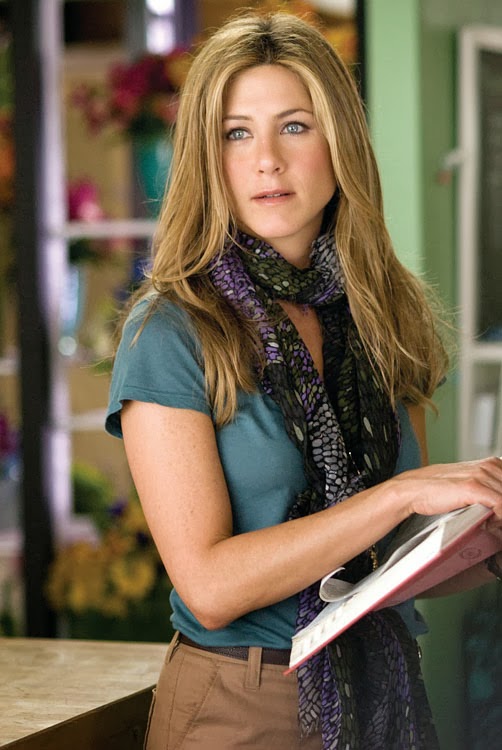
cinema obscura: Marc Klein's "Suburban Girl" (2007)

 
A sense of discovery, what used to be among the more simple pleasures in one's moviegoing life, has become such a rare and fleeting event nowadays that it is unappreciated and often misunderstood.

We've been conditioned to assume that any film - either a mainstream monstrosity from the studios or an indie darling from the festivals - that isn't hyped is suspect and must be bad. And must be avoided.

Marc Klein's first feature as a director, "Suburban Girl," went missing back in 2007 when it somehow fell off the fillm-fete assembly line and disappeared.  It played Cannes and the Tribeca Film Festival and all of the major markets in Europe but never quite made it back home.

Klein, a screenwriter whose credits include "Serendipity," "A Good Year" and, more recently, "Mirror Mirror," has fashioned a bittersweet relationship film (not to be confused with your standard romcom) about a young woman with some minor father issues who becomes involved with an older man with major daughter issues. He based it on two short stories, "My Old Man" and "The Worst Thing a Suburban Girl Could Imagine," from Melisa Bank's "The Girls' Guide to Hunting and Fishing," which was the film's working title. ("Suburban Girl" is a most unworthy moniker.)

Set in Candace Bushnell's New York, Klein's film is what one would expect from an episode of  "Sex and the City" written and directed by Woody Allen:  It is observant, literate, occasionally witty and quite tart.

And in the lead roles, Sarah Michelle Geller and Alec Baldwin do alert, deeply shaded variations on the Carrie Bradshaw-Mr. Big duet, adding some fascinating new wrinkles to an all-too-familiar theme. 

Geller, a solid actress who operates too often under the radar, is Brett Eisenberg, an associate editor whose talent and ambition are being smothered by her new boss at the publishing house where she works. 

Baldwin is Archie Knox, the Mailer-esque author - part writer, mostly womanizer - who wants to seduce and mentor her at the same time, forgetting that Brett is neither his mistress nor his daughter, but his equal. 

While this is very much Geller's film, which she carries with exquisite, attractive ease, Baldwin is commanding, both suave and sexually intimidating - and also touching - as an older man who is also an aging lothario.  Baldwin, whose life as a promising leading man in movies self-aborted, found his second act in Jack Donaghy, a character that, for better or worse, has invaded some of his other recent performances.  But not here.  Archie Knox is a character and performance that stands on its own, free of any Donaghy/Baldwin, Baldwin/Donaghy tics.

The large supporting cast includes turns by James Naughton as Brett's beloved father, Maggie Grace as her BFF/confidant and Mirian Seldes (Mr. Big's mother herself!) as a tony literary critic.

My theory on why this film fell through the cracks:  It's not really an indie and it's not really mainstream either,  which poses a marketing problem.  Klein, I suppose, could have easily made this for a major studio, but it's doubtful if Baldwin and Geller would have been the leads.

Which would have been a loss. 

The difficult-to-see "Suburban Girl"  can be found these days on the fringes of Showtime.  It airs again on Tuesday, May 21st @ 8:25 a.m. and on Thursday, May 30th @ 8:35 a.m. and also on ShoWomen on Thursday, May 23rd @ 7:30 a.m.  Check it out or (given these hours) record it.

You'll be suprised and gratified.  I hope.
 

irony


In his latest DVD column for The New York Times, the invaluable Dave Kehr details the recent output of Fox Cinema Archives, the one-year-old, manufactured-on-demand arm of 20th Century-Fox Home Entertainment,  questioning (and with very good reason) why Fox, of all studios, would eschew letterboxing for most of its wide-screen films.

In this particular case, for this particular studio, it frankly makes no sense.

Per Dave:  "...most galling of all, for the studio that fueled the wide-screen revolution of the 1950s with the introduction of CinemaScope, wide-screen films (are) presented in pan-and-scan versions reformatted to fit the televisions of the last century, with large parts of the image cropped out."

Yes, Fox was the driving force behind CinemaScope, the one studio that could be credited, without hyperbole, with introducing and nurturing wide-screen movies.  Whoever is making decisions at 20th Century-Fox Home Entertainment these days clearly is ignorant of his/her studio's august history.  Sad.  But rather typical. Fox should confer with Warner Bros., whose Warner Archive Collection repeatedly get things right.

Generally speaking, I don't learn much from modern movie reviews.  The days of great film journalism are gone.  But Dave is an exception.  I invariably come away from his essays enlightened about something.  And this particular observation jumped out at me. Bravo, Dave!

Wednesday, May 15, 2013

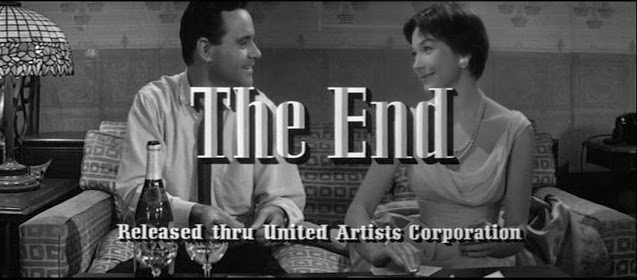
indelible moment: Wilder's "The Apartment"

 "I don't want people to think I'm an entertainer..."

From under the desk, C.C.("Bud") Baxter (Jack Lemmon) has produced a hatbox, and out of the hatbox a black bowler, which he now puts on his head.

Bud: It's what they call the junior executive model. What do you think?

Fran (Shirley MacLaine), the elevator operator on whom Bud has a crush, looks at him blankly, absorbed in her own thoughts. 

Bud (continuing): Guess I made a boo-boo, huh?

Fran (paying attention again): No - I like it.

Bud: Really? You mean you wouldn't be ashamed to be seen with somebody in a hat like this?

Fran: Of course not.

Bud: Maybe if I wore it a little more to the side - (adjusting the hat) is that better?

Fran: Much better.

Bud:  You don't think it's tilted a little too much.

Fran takes her compact out of her uniform pocket, opens it, hands it to Bud.

Fran: Here.

Bud (examining himself in the mirror): After all, this is a conservative firm - I don't want people to think I'm an entertainer...

His voice trails off. There is something familiar about the cracked mirror of the compact -- and the fleur-de-lis pattern on the case confirms his suspicion. Fran notices the peculiar expression on his face.

Fran: What is it?

Bud (with difficulty): The mirror - it's ... broken.

Fran: I know. I like it this way - makes me look the way I feel.
"(it) makes me look the way I feel"

Thursday, May 09, 2013

the fascinator


By any kind of measure, "Bates Motel," the A&E series inspired by the Robert Bloch book and the Alfred Hitchcock film, simply shouldn't work.

Functioning as a prequel that's set in the present (what?), it sounds too much like a conceit. But only on paper. In performance, it's terrific - thanks to astute, clever writing and the performances of Freddie Highmore as the young Norman Bates and by Max Thieriot (currently of "Disconnected") as the hunky older brother we never thought he had.

But the titantic supporting structure of the series is its most delicate-looking element, Vera Farmiga who plays Mrs. Bates - that's Norma Bates, to be specific - with a wink and an appreciation of nuttiness. Somehow, Farmiga's rapturous beauty both clashes with and compliments the deep-seated troubled soul that drives the ever-lovin', ever-conivin' Norma.

"Bates Motel" started out pretty much as an ensemble piece (its supporting cast is flat-out excellent) but Farmiga has become more prominent every week.  She has slowly, shrewdly assumed control of the show in much the same way that the willful Norma insidiously dominates her poor Norman.

I never thought that being smothered could be so blissful.

Sunday, May 05, 2013

déjà vu

Baz Luhrman's new version of F. Scott Fitzgerald’s "The Great Gatsby" runs 142 minutes.

Jack Clayton's 1974 filmization of the same material runs 144 minutes.

Coincidence?

Perhaps.

Baz Luhrman's "Gatsby" is breathlessly being ushered to the screen as a Big Event, replete with 3-D and gorgeous Leo as Jay Gatz.

Jack Clayton's "Gatsby," I hasten to note, was an even  bigger deal nearly 40 years ago, replete with a Francis Ford Coppola script and beautiful couple Robert Redford and Mia Farrow in the leads. Even more gorgeous.

Fact is, Clayton's "Gatsby" was the first to be sold as a modern movie event, predating "Jaws" by one year and the “Star Wars” assault by three years. (The Spielberg and Lucas films would simply up the ante.)
 
Time magazine devoted a 1974 cover story on the over-the-top hype that preceded and accompanied the opening of Clayton's film, and Farrow, as Daisy, graced the cover of the very first edition of People magazine.

This was all part of the overwhelming “Gatsby” marketing blitz which not only distracted from the many merits of the movie but also brought out the venom of critics - hence, the glib Canby dismissal ("as lifeless as a body that's been too long at the bottom of a swimming pool") that's been invoked in seemingly every New York Times article promoting the new version.  Me?  I rather like and admire the Coppola-Cayton version.

He says defiantly.

Back in '74, Robert Evans, the marketing Svengali behind Clayton's film, was quoted in the Time piece saying, "The making of a blockbuster is the newest art form of the 20th century."  Being interviewed for the new version of "Gatsby," Evans steps back, warning about about the temptation to “overcommercialize and overpublicize” the Fitzgerald source material

And he's correct but that's certainly what he did 40-plus years ago.

So, the only real point of Luhrman's remake is that very little has changed in the movie industry. Except for its  taste in music.

For his version, Luhrman elected to, well, baz things up by bringing in Shawn 'Jay Z' Carter to add some anachronistic background songs.

Clayton?  He had the actor William Atherton croon Irving Berlin's wrenching "What'll I Do?" over the main credits.  Much preferable.


Friday, April 26, 2013

indelible moment: Donen's "The Little Prince"

In the mid-1970s, Stanley Donen teamed up with Alan Jay Lerner and Frederick Loewe - you know, the guys who did "My Fair Lady" - for a musical film based on Antoine de Saint-Exupéry beloved gem, "The Little Prince"/"Le Petit Prince." The film was troubled given that the casting of The Pilot - Frank Sinatra, Gene Hackman, Jean-Louis Trintignant and Richard Burton were all suggested - proved gnawingly elusive.

Reliable Richard Kiley would play the role.

The resulting film ran a trim 88 minutes which was considered perfect in some quarters and suspect in others. Studio intervention? Hmmm. Donna McKechnie's role as The Rose seemed particularly truncated. But, overall, the movie is a tiny gem. Donen got it right, particularly in his casting of Bob Fosse as The Snake and, truly inspired, Gene Wilder as The Fox.

The film's stand-out moment is also the book's: It comes when Wilder, with his champagne-colored, fluffy hair and dressed in a handsome auburn suit, scurries about and stops in a field of wheat to intone:

"It's only with the heart that one can see clearly. What's essential, is invisible to the eye."

Lovely. And, yes, indelible.

Wednesday, April 17, 2013

that's my line!


Something happened at George Sidney's wrap party for "Bye Bye Birdie" in 1962 that caused a roomful of jaws to drop, a raunchy riposte that's been attributed to two different sources in two recent books.

Everyone was toasting everybody, with Sidney thanking all for their contributions to his film, when someone reportedly addressed Ann-Margaret directly. "Ann-Margret," the anecdote goes, "I just want you to know that I'm the only one here who doesn't want to (blank) you!"

In his companionable new memoir, "My Lucky Life (In and Out of Show Business)" (Crown), the star of the film, Dick Van Dyke, credits his co-star, the outrageous Paul Lynde, with the quip.

However, in his compulsively readable "Dropped Names: Famous Men and Women as I Knew Them" (HarperCollins), Frank Langella points to ... Maureen Stapleton who, by all accounts, was a pistol.

Frankly, I like Langella's version better - the imagery of it is funnier - but given that he was very young at the time (24) and wasn't there and that Van Dyke was, I have to think that Dick's is the more accurate one.

Van Dyke also recounts an eccentric bit of business by Stapleton during the party.  It seems she showed up with her own salad, which she ate with toothpicks, and spent most of her time sprawled out on the floor.

"Maureen, wouldn't you like a chair?," Dick asked her.  To which she answered: "I'd tell you where I'd like to sit, but your wife is here."

Incorrigible.

Note in Passing: Turner Classic Movies airs "Bye Bye Birie" @ 3:15 p.m. (est) on Sunday, May 5th.
 

cinema obscura: Richard Benner's "Happy Birthday, Gemini" (1980)

The late Richard Benner, who died in 1990, was a promising Canadian filmmaker who, for reasons unknown, directed only three movies.

He broke through in 1977 with the hugely entertaining "Outrageous!," a drag-queen farce driven by fine-tuned, yet comic, turns by the cross-dressing Craig Russell (who also died in 1990), the fetching Hollis McLaren, reliable Helen Shaver and the cult filmmaker Allan Moyle ("Pump Up the Volume" and "Empire Records"). A decade later, Benner made the less-successful sequel, "Too Outrageous!," and that was that.

End of film career; onward to TV, which also lasted only briefly.

In-between his two Russell farces, however, Benner made his best, most assured film - 1980's "Happy Birthday, Gemini," based on the Albert Innaurato stage comedy that was simply titled "Gemini" when it was staged off-Broadway twice within a year - first by Playwrights Horizons in December 1976 and then by the Circle Repertory in March 1977 - and again on Broadway in May 1977. To call Innaurato's piece "audience-friendly" was an understatment. It was irresistible, playing a whopping 1,819 performances on Broadway. Sigourney Weaver, Danny Aiello and Robert Picardo were among the cast in its various stage incarnations.

In those days, a successful stage comedy was automatically snapped up for the screen (not any more!) and when United Artists decided to film it, the project was handed to Benner on the basis of "Outrageous!"

Essentially a backyard comedy, set among row houses in South Philadelphia, "Happy Birthday, Gemini" revolves around the 21st birthday celebration of one Francis Geminiani - played on stage by Picardo and in the film by Alan Rosenberg - a gay kid who had the misfortune to grow up in a rough-hewn neighborhood. An antic comedy of manners ensues as various friends, relatives and neighbors crowd their way in, making a lot of arm-flailing, neurosis-revealing commotion.

These include Francis's father, Nick (Robert Viharo), and his girlfriend, Lucille (Rita Moreno); next-door neighbor Bunny Weinberger (Madeline Kahn) and her obese son Herschel (Timothy Jenkins), and Francis's classmates from Harvard, the twins Judith Hastings (Sarah Holcomb) and Randy Hastings (David Marshall Grant). It's like this - Sarah has a crush on Francis, who in turn has a crush on Randy.

Blessed with this pleasing cast, Benner almost effortlessly whipped up a most companionable film. The three young leads, all new at the time, are especially good. Rosenberg and Grant both went on to have modest film careers, but one has to grieve the loss of Holcomb, who debuted in "Animal House," had a commanding dramatic role in "Walk Proud" and was most fetching in "Caddyshack," but who reportedly gave up acting when show business proved too much of a source for drugs and alcohol.

A sad loss.

Anchoring the film with appropriately diva-like performances are old pros Moreno and Kahn whose bavura work here should have elevated Benner's pleasing little comedy to almost-classic status. As a film, it deserved as large an audience that it managed to attract three times over on stage.

Monday, April 08, 2013

cinema obscura: James Salter's "Three" (1969)


Sam Waterston, tall and dark, and Robie Porter, blond and hunky, with dream girl Charlotte Rampling in James Salter's lost film, "Three" (1969)
It's a thankless exercise delving into material already perfected by another filmmaker.

Just ask Paul Mazursky who, perhaps foolheartedly, challenged himself with the langorous relationship among two men and a woman in "Willie and Phil" (1980), despite the looming presence of Francois Truffaut's sublime "Jules et Jim" (1962).

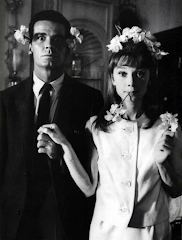
Mazursky wasn't the only one. In 1969, novelist James Salter directed "Three," his first - and only - film in which his 23-year-old ingénue Charlotte Rampling seductively drifts around hugely photogenic Mediterranean locations, distracting college buddies Sam Waterston and Robie Porter. The film follows them as they eat, drink, tour and flirt around the subject of sex.

It's about the simple of joy of just hanging out.

Salter, a name who still intrigues cinéphiles, wrote the stories on which Dick Powell's "The Hunters" (1958), Stacy Cochran's "Boys" (1995) and Sean Mewshaw's "Last Night" (2004) were based. He penned the screenplays for Sidney Lumet's "The Appointment" and Michael Ritchie's "Downhill Racer" (both 1969 releases) and Richard Pearce's "Threshold" (1981), and he collaborated on the script for Gregor Nicholas's "Broken English" (1996). And that's it. Often described as a "writer's writer," Salter went to school with Jack Kerouac.

Note in Passing: James Salter's difficult-to-see "Three" airs on Turner Classic Movies @ 10 (est) tomorrow morning - Tuesday, April 9th. Enjoy.